
 admin
admin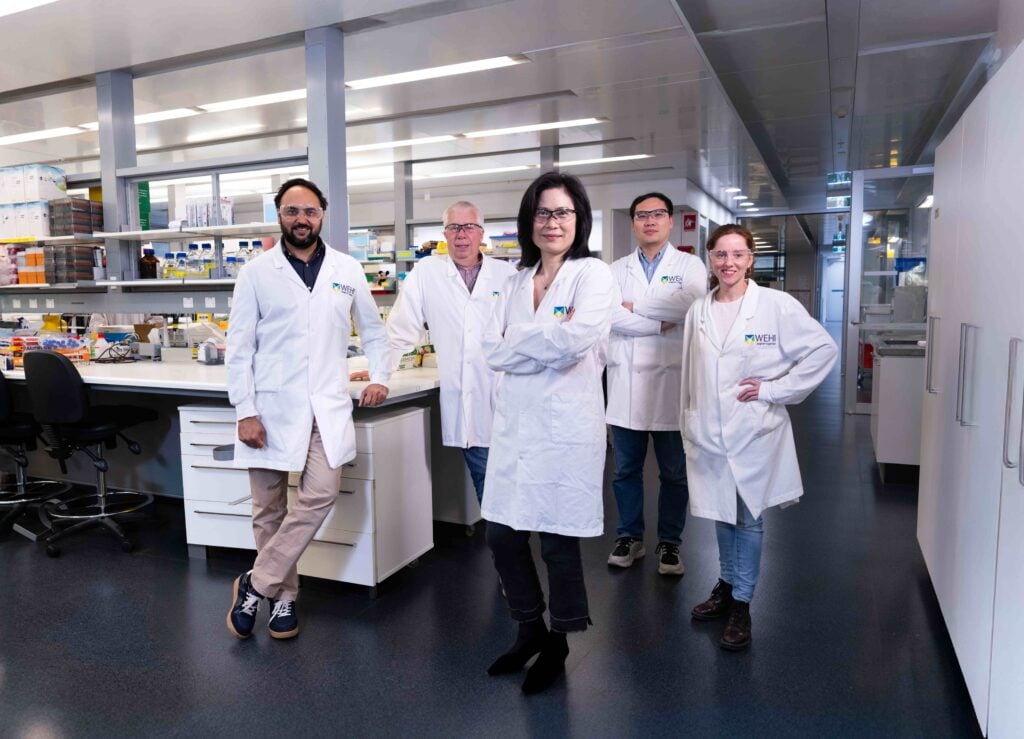
A bold plan to supercharge immune cell ‘spies’ to better seek out and kill cancer cells has received a $17 million funding boost from the Australian Government.
The WEHI-led project focuses on dendritic or ‘James Bond’ cells, which play a pivotal role in intelligence-gathering for our immune system, and aims to equip them with enhanced cancer fighting technology with the hope of revolutionising treatment for bowel and other solid cancers.
It is hoped the funding from the Medical Research Future Fund’s Frontier Health and Medical Research initiative will deliver much-needed new treatments for bowel cancer, Australia’s second biggest cancer killer.
The new project is a collaboration drawing on the expertise of researchers and clinicians at WEHI, Peter MacCallum Cancer Centre (Peter Mac), Mater Research and The University of Queensland, and Monash University.
At a glance
A major WEHI-led research project that aims to supercharge immune cells to attack solid tumours has received $17.1 million from the Medical Research Future Fund’s Frontier Health and Medical Research initiative.
The project will equip a specific type of the immune system’s dendritic or ‘James Bond’ cells, which help the body detect and identify threats, with the ability to better recognise cancer.
It’s hoped the project will lead to human trials within five years for an entirely new class of cancer treatments.
The ‘James Bond’ of our immune system
Despite advances in conventional treatments like surgery and chemotherapy, bowel cancer remains the second-leading cause of cancer death in Australia, and the leading cause among those aged 25-54.
The risk of being diagnosed with bowel cancer before the age of 40 has more than doubled since the year 2000. Treatment options are limited.
While modern immunotherapies that harness the power of the body’s defences to attack cancer cells have become standard treatment for some types of cancer, their efficacy is limited against solid tumours, like those in the bowel.
Dendritic cells have shown great promise as a cancer-fighting tool, in particular a subset of these called DC1s, which are specialised at generating a strong anti-tumour response.
Chief investigator and WEHI laboratory head Professor Shalin Naik said there is growing confidence that DC1s could be the missing link in the arsenal of immunotherapies to target solid tumours.
“Dendritic cells are the ‘James Bond’ of our immune system, gathering intelligence and alerting the immune system’s attack forces to what a virus, bacterium or cancer looks like, so they know what they’re looking for when fighting disease,” said Prof Naik.
“Our project aims to upgrade DC1s, a specific type of dendritic cell, so that they are better able to recognise and launch an attack on cancer cells.”
WEHI researchers have made significant contributions to understanding dendritic cells since 1992.
More recently, Prof Naik’s team discovered a novel way to generate many more DC1s from patient stem cells than previously possible, a crucial finding that has unlocked the potential for these cells to be harnessed to treat cancer.
Minister for Health and Ageing Mark Butler said the project was another example of world-class Australian science leading the way.
“We’re backing our researchers to turn cutting-edge discoveries into treatments that could save lives,” he said.
“Investing in homegrown research like this means Australians will benefit from treatments developed by our own scientists, using the latest in immunotherapy and cell technology.
“Too many families know the pain of bowel cancer. This project gives real hope for new therapies that could change the story for thousands of Australians.”
Supercharged cells
WEHI will work in partnership with Peter Mac’s Centre of Excellence in Cellular Immunotherapy with the aim of advancing a novel dendritic cell-based therapy to a clinical trial within five years.
“This project will leverage Peter Mac’s expertise in the onsite manufacture, first-in-human clinical trials and routine administration of breakthrough cellular therapies, such as CAR T-cell and dendritic cells, for Australian patients,” says Professor Simon Harrison, Director of the Centre of Excellence in Cellular Immunotherapy at Peter Mac.
“We are excited to team up with WEHI to advance dendritic cells as a novel therapy we hope can do for solid tumours, like bowel cancer, what CAR T-cell therapies have achieved in blood cancers.”
The team aims to supercharge DC1s with chimeric antigen receptors (CARs), using similar technologies to those that have revolutionised immunotherapy treatments for blood cancers.
Lead chief investigator and WEHI laboratory head Professor Stephen Nutt said that infusing DC1s with CARs would effectively upgrade their arsenal and spyware.
“We think these supercharged cells have the potential to revolutionise treatment for bowel cancer and other solid tumours, which are in critical need of next-generation therapies,” said Prof Nutt.
“This funding is a game-changer, allowing our team to develop this new therapy and bring it all the way to testing in patients.
“It’s our strong hope that this research project delivers a new class of cell-based cancer therapy, that leverages our immune system in new ways to improve survival, and quality of life, for patients.”
Project team members: Professor Stephen Nutt, Professor Shalin Naik, Dr Cindy Audiger, Dr Shengbo Zhang (WEHI), Professor Jeannie Tie (WEHI and Peter Mac), Professor Kristen Radford (Mater Research and The University of Queensland), Professor Simon Harrison (Peter Mac), Associate Professor Meredith O’Keeffe (Monash University).

 vritimes